Sunday, 3 February 2013

Latest News on Restoration of an 1811 Flight and Robson Chamber Organ

Just before Christmas I was able to locate the casework on the new base that I had made. In addition to the building frame that was required in order to support the windchest and new bellows, I had to make new side panels and most of the front panels. They still need finishing and, of course, the upper panels need to be stripped, repaired and polished. However, it is possible to see how the finished organ will look, at least in general aspect. The internal action is slowly coming together. More urgent jobs in the workshop - meaning other organs that are being restored for particular clients -  have now displaced work on the F&R organ - that is, until a buyer comes forward!


Sunday, 20 May 2012

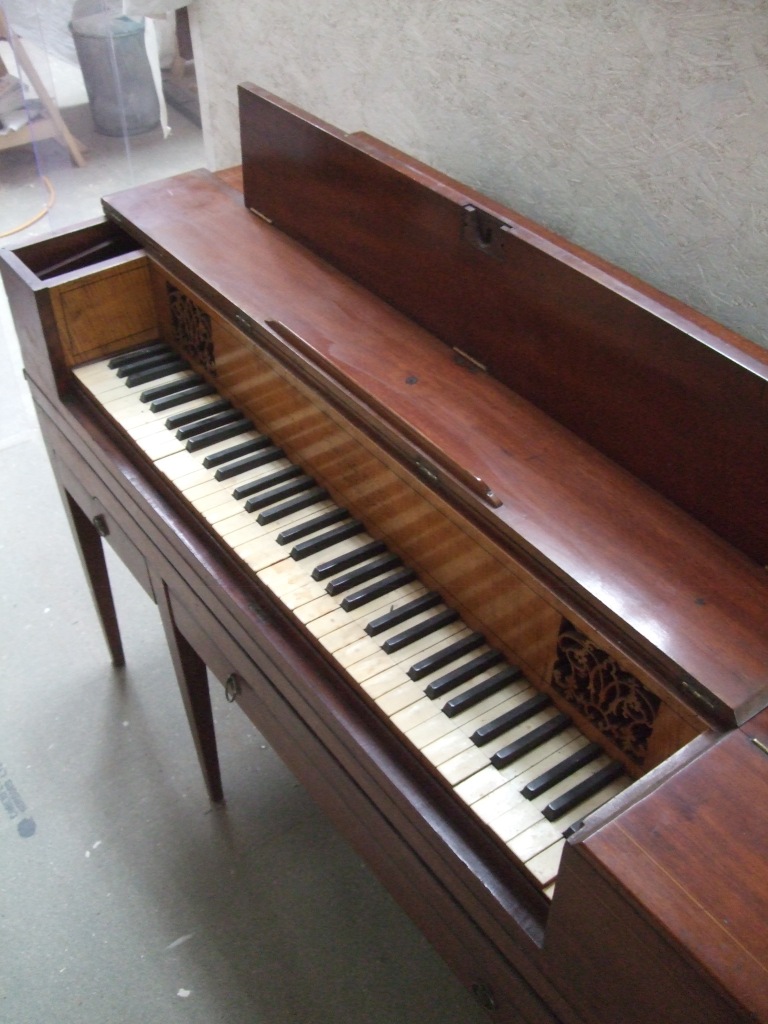
Early 19C square piano by William Gray

For a long time I have wanted to own a square piano. Square pianos are not, of course, square but rectangular.  A few weeks ago one came up at an auction nearby and I was the successful bidder. I was particularly pleased to find that it was made by someone better known as an organ builder, William Gray (c1757-1821). It appears that Gray advertised himself as a pianoforte maker in the the early 1800s. There are two earlier pianos known by Gray and were made jointly with his brother Robert who died in 1796. Mine is the only one (yet) that I have found to bear his name alone.
Here is the nameboard - no date or number - with calligraphy typical of the early decades of the 19C

The solid mahogany case has some small repairs and needs some more but there is some nice inlay work and what appears to be original brass work.

The action is now all taken out and the cloths (not felt) have all been well eaten by moths. A number of hammers need to be made and they all need new vellum or goatskin hinges. I suspect that there has been some restoration, but a long time ago, and many of the original overwound bass strings are still there.

The main thing about this restoration project (for myself this time not for the business) is that these pianos date form a time when everything required can be made from readily available materials (wood, leather, cloth [of the right kind], iron and brass) using tools that are found in a reasonably equipped but not specialist workshop. In short they have the same appeal for me as the early organs.

Saturday, 19 May 2012

Chamber organ update

Time flies when you get down to nitty gritty of a restoration project. Rebuilding an organ that has key bits missing - bellows, most of the lower case work and building frame, as well as having the solid mahogany that is left painted a garish colour - was always going to take a while. So far, a new set of bellows and feeders has been made and the frame and lower panels have all been made. The wind chest has been totally disassembled. I found that patches had been put over patches, so there was nothing for it but to get back to the woodwork. Having done this - taking the action apart and stripping out the pallets which had been recovered in 1921 - the frame, bars and upperboards were found to be in good condition, i.e. no worm or serious cracks. It seemed a good opportunity to make detailed measured drawings as the details of the construction could be clearly seen. Furthermore, I decided to make a copy of the chest for a new chamber organ - there is no point in reinventing the wheel if a competent builder like Flight and Robson has already devised a compact layout that works. In addition, building a copy when you have the original to hand helps to sort out problems as they arise. In my case, discovering that an accurately made rectangular frame went out of square overnight. Getting it square again was not a problem and a few diagonal temporary braces keep the whole thing is shape while I begin to put in the bars.

Wednesday, 14 December 2011

Update on the organ at Biddulph Moor

The dismantling of the Samuel Renn organ at Biddulph Moor in north Staffordshire is now complete and it is in storage awaiting restoration and a new home.
Now you see it......
... now you don't!
Notice that a fair bit of plaster work has come away from the wall at the lower right-hand side. This wall was incredibly damp and many of the screws on this side of the organ were badly corroded and taking them out really slowed things down. Much of the plaster came away when we removed the pedal bourdon pipes from that side.

Notice also the heating pipes that were under the organ. At some point the entire organ had been raised about a foot so that the pipes could be placed underneath. The organ had been slowly cooked for many years!

Sunday, 13 November 2011

Something different

I haven't posted anything for the past few days because:- 1. My laptop notebook has given up the ghost, and 2. I have been in north Staffordshire taking out an organ. I am hoping that our local friendly PC technician can at least recover the contents of my hard disk, if unable to revive the computer itself. With regards to the second excuse, well, that it part of my business.

The organ that I am removing is a rather interesting example of the work of Stockport/Manchester organ-builder Samuel Renn (1786-1845). Firstly, the rather impressive gothic front of the case has survived more or less intact as well as one of the side panels. Secondly, much of the original Great pipe work is intact as is a lot of the Swell including a 'choir bass' that allowed the tenor C Swell to have some notes in the octave below. Although the facade pipes do speak, they do so on small pneumatic chests which were installed when the case front was moved forward sometime during the 20th century. Mercifully, this is all reversible and when the facade is moved back to its original place directly in front of the Great windchest the pipes can be directly winded by short conveyances. The two pedal windchests retain their original mechanical action. The scale of the bottom pipes of the Bourdon is a sight to behold and easily merit what was probably their original title of 'Grand Bourdon'. Even more interesting was to find that the case has been cut somewhat at the top - not just the missing tips of the pinnacles, the loss of which local knowledge attributes to a previous incumbent, but also a corner of each side of the centre panel. If my current best guess about the origins of this organ are correct then this older mutilation dates back to the 1850s when the organ was fitted into an upper gallery in St Lawrence's Parish Church in Chorley, Lancashire. Around 1859 the architectural historian Sir Stephen Glynne visited the church and noted that the case of the organ there had been cut to fit it in. Once again these alterations can be reversed.

One footnote here: as I dismantled the organ I came across various bits that were broken, all of which could be fixed by anyone with basic tools and materials. This is in stark contrast to my laptop, which, however helpful it is to me, is a complete blackbox that has defied all my efforts to fix it. I will be interested to see what the problem is, but I am prepared to bet that it will involve either. the use of a special bit of software, or, replacement of a bit that cannot be repaired. Spoken like a true Luddite!

Wednesday, 2 November 2011

Lower frame - Part 2

One other thing that I needed to do on the frame was to cut and fix four upstanding boards on which the lower mahogany panels will sit. This being done it also afforded an opportunity to check that my measurements were OK and that I had left enough room for the retracting keyboard to pass between the two side panels and below the two small stop jambs. So I clamped the panels onto the front of the frame where they will go as shown here and measured the relevant gaps


I know from past experience that it pays to check things like this as you go along. The earlier you spot a mistake the easier it is to fix! One way for errors to creep in is that I am drawing the plans at 1:2 scale and it is the easiest thing in the world is to take a measurement from the plans using a ordinary ruler rather than the scale ruler.

Tuesday, 1 November 2011

A new lower frame for the chamber organ

Here is the lower frame for the Flight and Robson chamber organ. For the moment is is only fitted together 'dry' i.e. I haven't yet glued the mortise and tenon joints that hold it all together. The frame will provide a base for the casework as well as supporting the windchest and pipework. The bellows will fit inside the frame and they are the next thing to make.

 This is the frame turned over so that the rollers can be seen.

This is a close-up shot of one of the rollers. These will eventually be hidden by a plinth made of mahogany to match the rest of the casework.